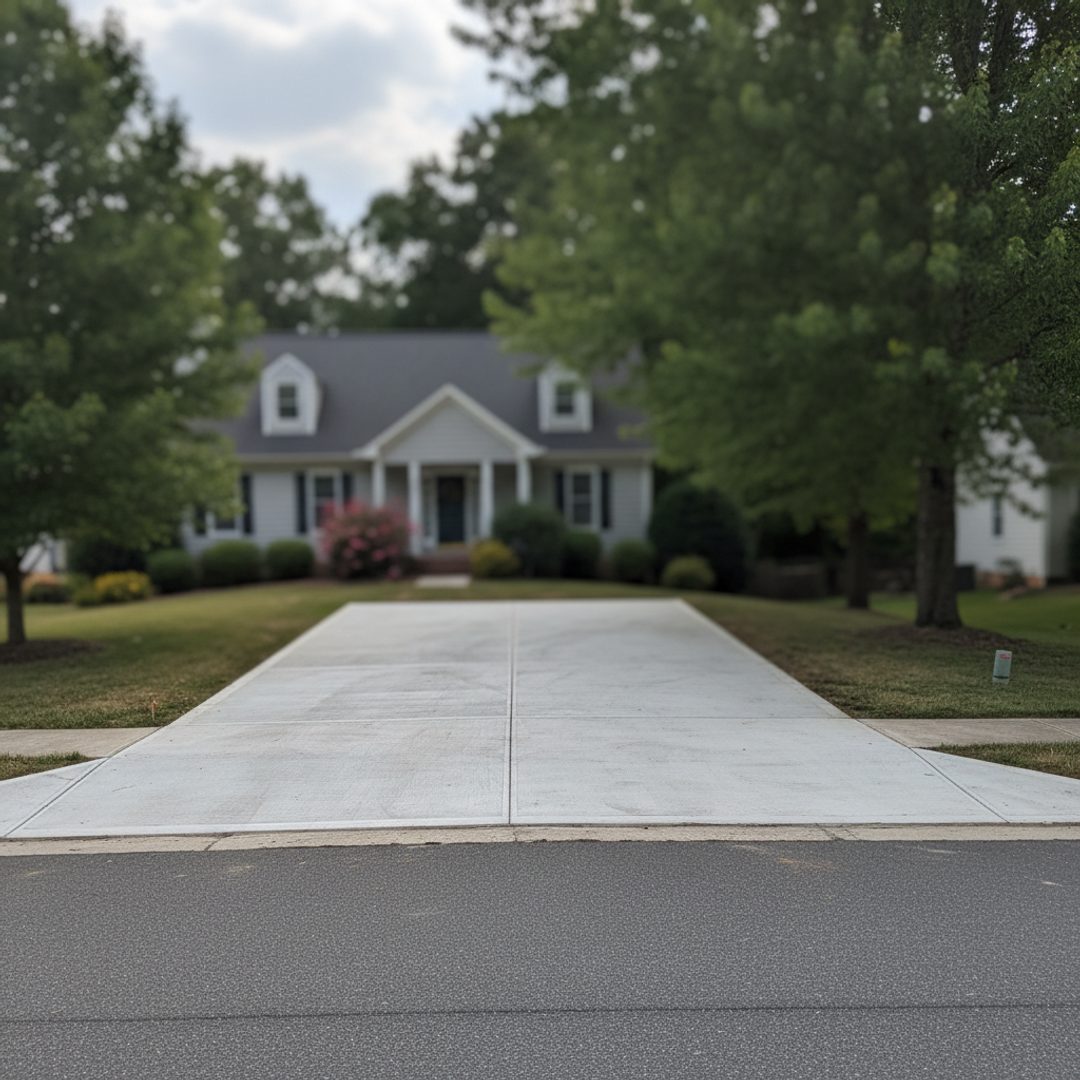
People ask us this question expecting a simple answer, like "spring" or "fall." The honest answer is that concrete doesn't care about the calendar. It cares about temperature, moisture, and what the ground under it is doing. In Richmond, those three things move around enough through the year that timing really does change how a slab turns out, and it's worth understanding why before you schedule a pour.
What's actually happening while concrete cures
Fresh concrete isn't drying, it's reacting. Cement and water go through a chemical process called hydration, and that process is what gives you strength. It needs to happen within a certain temperature window, roughly 50 to 90 degrees Fahrenheit at the surface, to go the way it's supposed to. Below 40 degrees, hydration slows down close to a stop. Above 90, especially with Richmond's summer humidity on top of it, the surface can dry out faster than the chemistry underneath can keep up. Either extreme causes real, visible problems later, not just a slower schedule.
Winter: the freeze risk is in the first 48 hours
Richmond sits in zone 7a, so we get somewhere around 30 to 40 nights a year that dip below freezing, usually from mid-November through early April. That's mild compared to a lot of the country, but it's not nothing. The danger isn't pouring concrete in cold weather in general, it's water in the mix freezing before the slab has gained enough strength to withstand it. If that happens in the first 24 to 48 hours, you get surface scaling, a kind of flaking or crumbling on the top quarter-inch that never really goes away. We can work through a cold snap with insulated blankets, heated water in the mix, and sometimes an accelerator, but it adds cost and it adds risk. A steps-and-porch job or a small repair can be managed this way. A full driveway pour on a 28-degree morning is not something we'd recommend, and any honest contractor should tell you the same.
Summer: the problem flips to moving too fast
July and August in Richmond regularly put the air in the 90s with humidity that makes it feel worse. On a sunny afternoon, a slab's surface temperature can run well above the air temperature. Concrete poured under those conditions can lose an inch of slump in half an hour, and the surface can dry out before the slab underneath has set. That causes plastic shrinkage cracking, thin surface cracks that show up within hours of the pour, sometimes before we've even left the site. The fix isn't complicated, it's pouring early in the morning, using fog misting to keep the surface from flashing off, and getting curing compound or wet burlap down fast. It works, but it means a 5 a.m. start in August instead of a civilized 8 a.m. one.
Rain, clay soil, and what the ground is doing underneath
Most of Richmond and the surrounding counties sit on Piedmont clay, which swells when it's wet and shrinks when it's dry. That matters more than people think, because a slab is only as stable as the soil under it. Pour on subgrade that's saturated from a wet spring and you're building on something that's going to shrink as it dries later, which can pull the slab down unevenly. Pour on soil that's bone dry and compacted hard, and you lose some of the natural cushioning that helps the slab handle minor ground movement. We want subgrade that's damp but not soft, which in practice means waiting a few days after a heavy rain before we bring in the forms.
Richmond gets a decent amount of rain spread through the year, with spring months often the wettest and a second wet stretch in late summer when tropical systems moving up from the Gulf or off the Atlantic drop heavy rain in August and September. A driveway or patio project near the James River corridor or in a low spot of a yard needs grading thought through before the pour, not after, because standing water against a new slab edge will find every weak point over the following winter.
So what's actually the best window
In practice, late April through early June and mid-September through October give us the most predictable conditions: daytime highs in the 60s and 70s, nights that stay above freezing, and soil that isn't swinging between soaked and bone dry. That's why those windows book up fastest, and it's worth calling a few weeks ahead rather than the week you decide you want a new patio.
That doesn't mean winter or summer work is off the table. Garage floors, steps, retaining walls, and repair work can often be scheduled in the shoulder parts of those seasons without much compromise, since smaller pours are easier to protect and manage. Large driveway slabs and stamped concrete patios are where timing matters most, because stamping in particular depends on getting the surface worked at exactly the right stage of set, something that's harder to control when the weather is fighting you.
A note on permits and the practical schedule
If your project needs a permit, through the City of Richmond or through Henrico, Chesterfield, or Hanover County depending on where you are, that review adds time before the pour date even gets picked. Older neighborhoods like the Fan or Church Hill often have existing utility lines, old footers, or tree roots in the way that a newer subdivision in western Henrico won't have, which can affect how long site prep takes. HOAs are common in the newer subdivisions and sometimes have their own approval step for anything visible from the street, like a driveway or front walkway, so it's worth checking that before you set a date you're excited about.
If you're planning work for this year, the best thing to do is get the site looked at now rather than waiting until the week you want it poured. That gives time for permitting, for the soil to be in a workable state, and for scheduling around whichever season actually suits the job. You can see the kind of work we handle at Champion Concrete Solutions, and we're happy to walk a site and talk through timing before anything's on the calendar.